A listing agent pulls the survey, checks the flood zone, orders the inspection, and thinks the coastal paperwork is handled. Then, a week before closing, a buyer's engineer asks a question nobody on the seller's side expected: which setback line does this lot actually sit behind, the state's or the city's? For a stretch of oceanfront and near-oceanfront property in New Smyrna Beach, those are two different lines, and they don't always agree with each other.
That gap between the state's Coastal Construction Control Line and the city's own Coastal Construction Setback Line is the kind of detail that rarely shows up until late in a transaction, and it's compounding with a second change this year: Florida's flood disclosure form got broader teeth in October 2025. Put those two together with where the local market actually sits in 2026, and the thesis is simple. Sellers here aren't just filling out more paperwork than they used to. They're selling into a market with less room to absorb a late surprise, which makes getting ahead of both of these issues worth real time before a sign goes in the yard.
Two Lines, One Beach
Most Florida coastal cities lean entirely on the state's Coastal Construction Control Line, set by the Florida Department of Environmental Protection to mark where beach and dune stability rules kick in for new construction. New Smyrna Beach doesn't fully rely on it. The city has run its own Coastal Construction Setback Line since the early 1970s, originally tied to a Department of Natural Resources line from 1973, later replaced by the state's CCCL in 1991. Rather than retire its version, the city kept a separate line on the books, and the two don't sit in the same place along the whole coastline.
The practical effect splits at Sapphire Road. City planning documents describing a proposed 2016 amendment to adopt the FDEP line as the city's own note that doing so would, in most cases, hand property owners north of Sapphire Road more usable land, while south of Sapphire Road the setback would shift further inland and become more restrictive. The segments between Crawford Road and Flagler Avenue, and from Flagler Avenue south to the city limit, each carry their own history in how the line was drawn. None of that is visible on a standard survey unless someone knows to ask for it.
North of Sapphire Road | South of Sapphire Road | |
|---|---|---|
Effect of aligning city line with state CCCL | More buildable land in most cases | Line shifts further inland, more restrictive |
What a seller should pull | Current CCSL and CCCL overlay from the city's Engineering Department | Same, plus any prior variance history for the parcel |
For a beachside seller, this means a setback line that reads as fixed for decades can still be more or less restrictive than a buyer's agent assumes, depending on which side of Sapphire Road the lot falls on. It's worth a call to the city's Engineering Department at 214 Sams Ave before listing, not after an inspection turns up a question nobody prepped for.
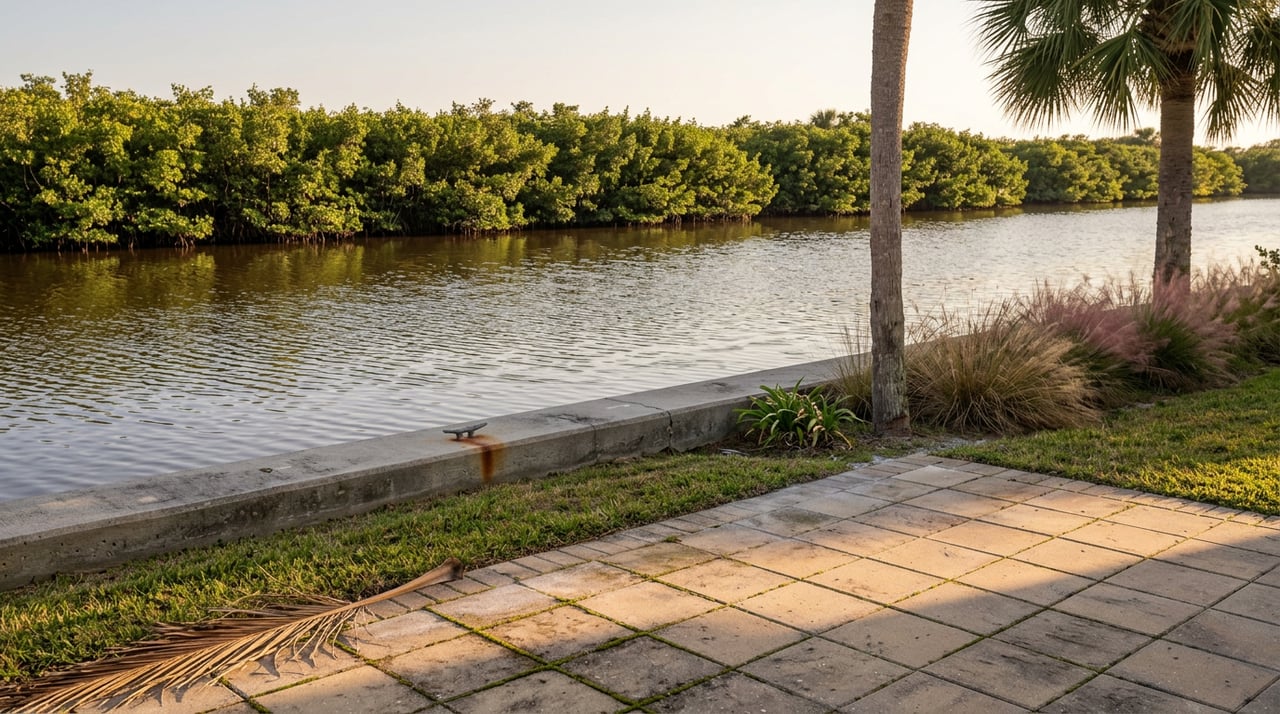
The city's own planning history is blunt about what has and hasn't been allowed seaward of that line. One older ordinance description of the setback area put it plainly: "the only construction permitted was a seawall or bulkhead on private" property, full stop. That standard has been the baseline in New Smyrna Beach for longer than most current listings have existed, and it's the reason so many older beachside lots have a seawall as their only structure east of the line while newer construction elsewhere pushes further.
The Disclosure Form Got Longer This Year
Florida's mandatory flood disclosure form, tied to Florida Statute 689.302, used to ask two questions: had the seller filed a flood insurance claim, and had the property received federal flood assistance. Effective October 1, 2025, the state expanded that form. Sellers now have to disclose known flood damage that occurred during their ownership whether or not they ever filed a claim or accepted assistance. A homeowner who mopped up water after a storm, patched the baseboards, and never called an insurer still has something to write down.
That change sits on top of a legal duty Florida has had since the 1985 Johnson v. Davis decision, which requires sellers to disclose facts that materially affect a property's value when those facts aren't obvious to a buyer and the buyer doesn't already know them. The flood form didn't invent that duty. It just gave it a specific, dated line item that buyers, lenders, and their attorneys now expect to see filled out, not skipped.
For New Smyrna Beach specifically, where much of the shoreline sits in FEMA Zone AE or Zone VE and the rest in Zone X, this isn't an abstract compliance exercise. Zone VE properties near the inlet carry the most direct wave-action exposure, and the disclosure now asks about actual water intrusion, not just paperwork history. Sellers who assume "no claim" means "nothing to disclose" are working from the old version of the form.
What the Current Market Actually Rewards
Here's where the disclosure timing matters more than it would have three years ago. As of January 2026, New Smyrna Beach homes were selling at a median sale-to-list ratio of roughly 92 percent, and the market carried about 3.87 months of supply, both signs that buyers, not sellers, are setting the pace on price and terms right now. Homes were also taking a median of about 58 days to sell as of that same month, and by early 2026 the median sale price had moved to around $510,000 on a 30-day trailing basis, up from $434,585 back in December 2023.
A market with more than three months of inventory and a sale-to-list ratio under 95 percent is not a market where a buyer facing a late disclosure surprise simply shrugs and closes anyway. It's a market where that buyer has other listings to look at and a lender who will ask hard questions if the flood form gets amended mid-contract. The math works against sellers who treat disclosure as a formality: every week a deal stalls over a paperwork gap is a week closer to a price reduction, and by January 2026 the share of New Smyrna Beach listings carrying at least one price reduction had already climbed to 77.32 percent.
None of this means beachside and waterfront property is a hard sell. It means the sellers who move fastest are the ones who hand a buyer a clean file on day one: survey, setback documentation, flood disclosure filled out completely, insurance and claims history organized before the first showing.
Getting Ahead of It Before You List
A few concrete steps close most of the gap described above. Pull the current CCSL and CCCL overlay for the parcel from the city's Engineering Department rather than relying on an old survey. Check the property's current FEMA flood zone designation, since Volusia County's maps are part of FEMA's broader Risk MAP 2.0 review running through 2025 and 2026, and some parcels currently in Zone X could shift into AE or VE in a future revision. Complete the FD-1 form honestly and early, including any flood damage from ownership even without a claim on file. If there's a seawall, gather permit history for it specifically, since seawalls carry their own maintenance and repair rules under both the state and city setback frameworks.
None of this is about scaring a seller out of listing. It's about making sure the first offer that comes in doesn't get renegotiated three weeks later over something that could have been on the table from the start.
A Few Questions Worth Asking Before You List
Does every New Smyrna Beach property have a different setback line than the state's CCCL? No. The distinction matters most for lots along the immediate oceanfront and near-oceanfront corridor, particularly on either side of Sapphire Road. Inland and Intracoastal-side properties are far less likely to be affected.
If I never filed a flood insurance claim, do I still need to disclose flood damage? Under the version of the FD-1 form in effect since October 1, 2025, yes. The disclosure now covers known flood damage during your ownership regardless of whether you filed a claim or received assistance.
Is a buyer's market bad news for sellers here? Not necessarily, but it changes the margin for error. With months of supply above three and sale-to-list ratios under 95 percent as of early 2026, buyers have more room to walk away from a deal that develops late-stage disclosure friction, so front-loading the paperwork protects the price you're asking, not just the closing date.
If you're weighing a sale on the beachside or along the Intracoastal in New Smyrna Beach and want a second set of eyes on the setback and disclosure details before you list, Todd Hammond has spent years walking coastal Volusia sellers through exactly this kind of paperwork. Let's Connect.
