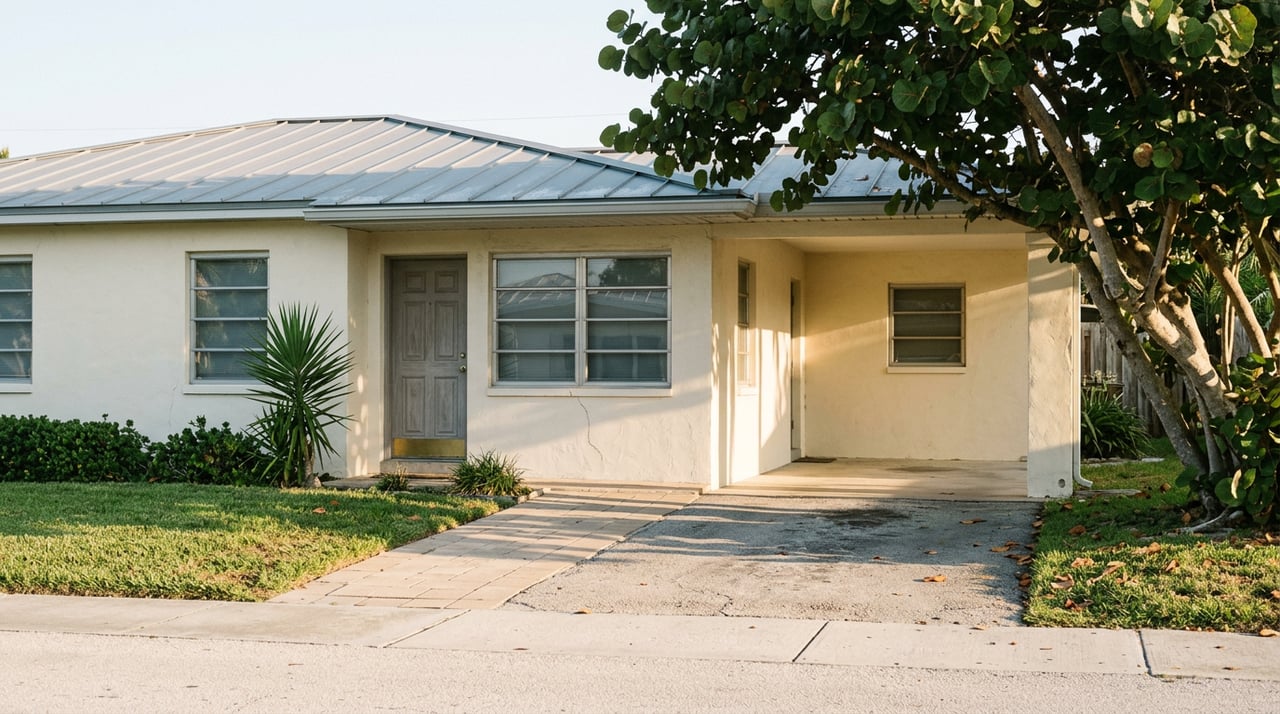
Drive north on Ocean Shore Boulevard past Granada Boulevard and within two blocks you'll pass a low block cottage with jalousie windows and a carport, probably built before Kennedy took office, sitting a few lots down from a four-story gated building with a resort-style pool and a private elevator. Same street. Same ZIP code. Same beach, more or less the same view. Based on how those two kinds of homes actually sell, they might as well be in different markets. That's not a sales pitch. That's what the closed transaction data for Ormond-by-the-Sea shows heading into the back half of 2026.
The Numbers That Don't Quite Agree
Two portal trackers give two different pictures of how fast homes are moving here, and both are worth sitting with rather than picking one and ignoring the other.
Looking at January 2026, one tracker showed the median sale price in Ormond-by-the-Sea at $375,000, up 13.6% from a year earlier, with the average home taking 174 days to sell compared to 46 days the prior January. A separate tracker's most recent rolling 30-day window, captured in late May 2026, showed a median of $410,000, up 13.9% year over year, with a median of 72 days on market and only 11 homes sold that month, down from 16 the year before.
Both agree prices are climbing at roughly the same clip, close to 14% year over year. They disagree sharply on pace. Part of that is simply math working against a small sample. When only 11 to 19 homes close in a given month, whichever handful happens to sell that month can swing the median and the average days-on-market figure by a wide margin. That volatility is itself a clue. It means the headline number isn't describing one steady market. It's describing whichever mix of old and new inventory happened to close that particular month.
One Peninsula, Two Building Eras
Public housing data shows most of the structures on this barrier island were built between 1940 and 1969, which lines up with what you'd expect walking the side streets between A1A and John Anderson Drive: small, well-kept single-family homes and low-rise condo buildings from a much earlier construction era than what's rising a few blocks away.
Recent closed sales tell that story with real addresses. Within about a week of each other in late February and early March 2026, 119 Essex Drive closed at $270,000 after 100 days on the market, while 146 Via Madrid Drive sold for $410,000 in 90 days and 128 Via Madrid Drive, a few doors down, closed at $430,000 after 179 days. The same week, 2900 John Anderson Drive, which fronts the Halifax River, closed at $1.14 million, a different price tier entirely.
Even within the resale tier, condition and pricing strategy still move the outcome, which is why two homes on the same street can take twice as long as each other to sell. But the real split shows up when you set that whole cluster of $270,000 to $430,000 closings against what's happening a few blocks north in the new gated buildings.
What's Actually Pulling the Median Up
The other half of the story is what's getting built right now. Bailey by the Sea, a gated condominium at 2360 Ocean Shore Boulevard, sits on nearly 2.4 acres and includes 32 residences across four stories, 13 of them directly oceanfront, with a resort-style pool and deeded beach access built into the HOA. As of local reporting from spring 2026, the project was about 90% complete, with unit pricing well into seven figures. Down the road, Verona Oceanside, a community of single-family homes and townhomes built by ICI Homes, has been in its final closeout phase with direct ocean access as one of its selling points.
When a handful of $1 million-plus units close in the same window as a batch of $270,000 to $430,000 cottages, the median doesn't describe a "typical" home here. It describes an average of two populations that don't otherwise compete for the same buyer.
Postwar resale stock | New gated construction | |
|---|---|---|
Typical era | Built 1940s to 1960s | Built 2020s |
Recent closed range | Roughly $270,000 to $430,000 | $1 million and up per unit |
Pace | Often sits for months, price reductions common | Tends to move faster once available |
Due diligence wrinkle | Septic and well system age and condition | Standard condo document and HOA budget review |
The Reason So Many of Those Older Homes Are Still on Septic
This is the part that surprises buyers coming from almost anywhere else in Florida. Ormond-by-the-Sea is unincorporated Volusia County land, not the City of Ormond Beach, even though the city supplies water to homes north of Plaza Drive between A1A and John Anderson Drive. What the city has never supplied is sewer.
An estimated 4,000 septic systems serve the peninsula. A 2013 Florida Department of Health study, cited repeatedly in local reporting since, rated three of the five worst septic locations in the entire county as being right here and labeled the North Peninsula not suited for septic in the first place. Porous soil, a high water table, and dense lot spacing all work against the systems doing what they're supposed to do.
The most detailed public accounting of what might change here comes from Ormond Beach city meetings and local reporting in 2019. At that time, city commissioners had voted to set aside $1.1 million to design and permit the first phase of a sewer conversion, covering roughly the streets between Plaza Drive and Longwood Drive. Ormond Beach's mayor at the time, Bill Partington, described the full project as ten phases in total and called it a multi-year, multi-million-dollar undertaking. Volusia County Councilwoman Heather Post, interviewed that same year, was more specific about what residents further up the peninsula should expect:
"I'm going to imagine that in 20 years, that will absolutely be the conversation."
Post put the likely cost at roughly $13,000 per household whenever conversion does happen. I found no newer public reporting indicating that timeline has moved since. That means anyone buying resale here today is buying into a septic system with no confirmed sewer date, which makes it a real line item to raise before closing: how old is the tank, when was it last inspected, and has the seller had any issues with drain field performance.
The Beach Isn't Uniform Either
The same block-by-block variation shows up in how residents actually reach the water. Along this stretch of coastline, some access points are simple sidewalks down to the sand, others are ADA-compliant dune walkovers, and a few are stairs cut straight through the dune. The Ormond Scenic Loop and Trail's own beach access map lists a mix of these along Ocean Shore Boulevard, and it matters which kind sits closest to a given address. A gated new-construction building with deeded, private beach access is a different daily experience than a postwar cottage three blocks from the nearest public walkover, even if both are technically "steps from the beach" in a listing description.
What This Means If You're Comparing Neighborhoods
If you're weighing Ormond-by-the-Sea against the Ormond Beach mainland or Daytona Beach Shores, the median price alone won't tell you much here. Ask instead what specific inventory is driving that number in the window you're looking at. Ask whether a listing is on well and septic or tied to a newer building's own systems. Ask how long comparable homes, not just any home in the ZIP code, have actually taken to sell recently. A three-month-old comp on a gated new build says very little about how long a 1958 cottage two streets over might sit.
None of this makes Ormond-by-the-Sea a harder place to buy well. It makes it a place where the headline number needs a follow-up question before it's useful.
If you're trying to figure out which side of that split a specific address falls on, or how it compares to what's available in Ormond Beach proper or further south, that's exactly the kind of conversation I have with buyers every week. Todd Hammond would love to walk through the current inventory with you and help you read past the median to what a specific block actually offers. Let's Connect.
A Few Questions Worth Asking Before You Tour
Is Ormond-by-the-Sea part of the City of Ormond Beach? No. It's an unincorporated community governed by Volusia County, though it shares the 32176 mailing ZIP and gets its drinking water from the City of Ormond Beach.
Does every home here still have a septic tank? Not every home, but a large share of the older housing stock does, with an estimated 4,000 septic systems across the peninsula according to the most recent public reporting available. The exact water and wastewater arrangement for any specific property, old or new, should always be confirmed during due diligence.
When will sewer reach my street? There's no fixed date. Local officials have described the full conversion as a decades-long, multi-phase project, with early work concentrated on the streets closest to existing city sewer lines near Plaza Drive. Anyone relying on a septic system today should plan around the system they have, not a conversion timeline that hasn't been set.
